
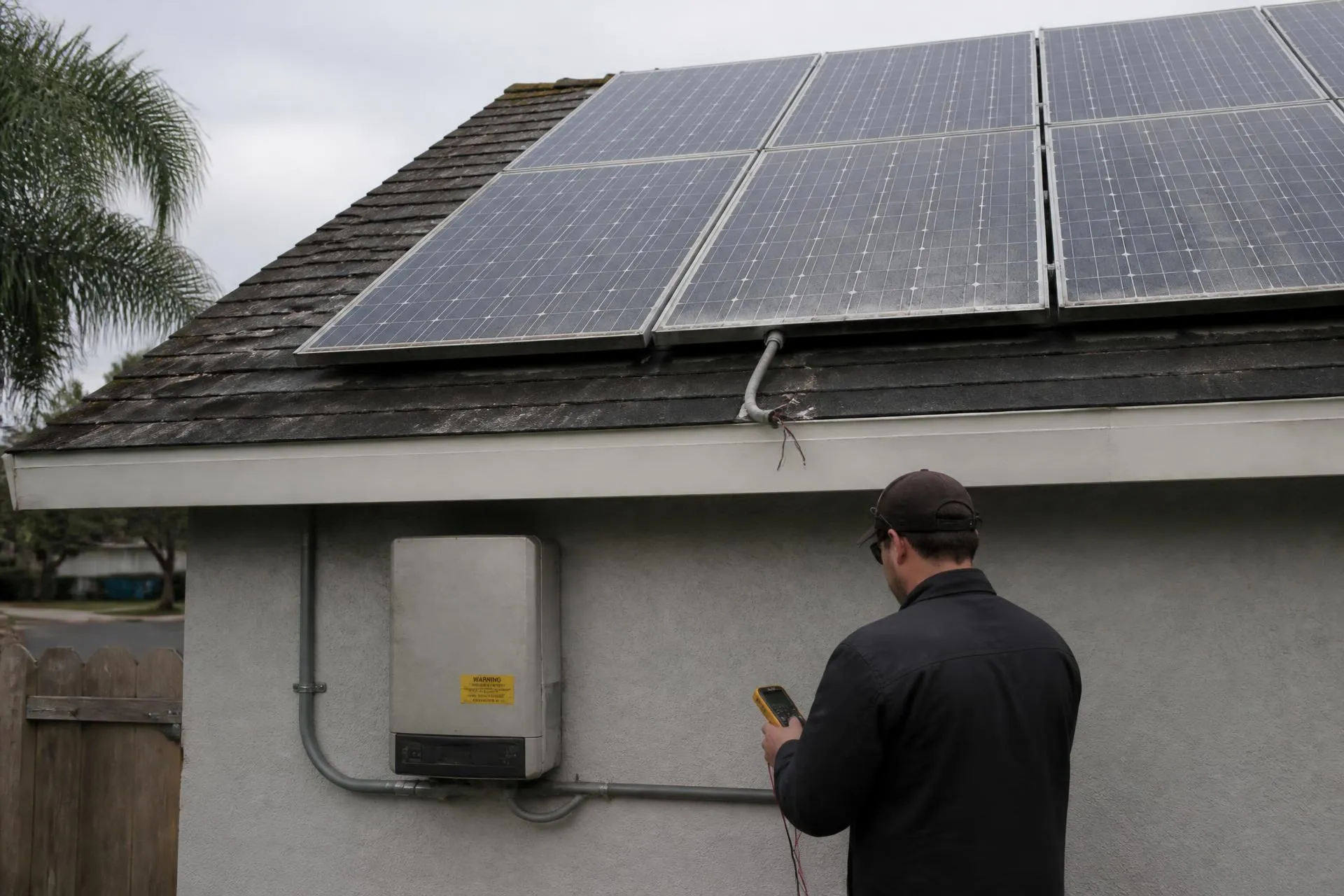
Your installer closed.Your systemdoesn't have to.
Hundreds of Southern California homeowners get the same call every year, the company that installed their solar has closed, gone bankrupt, or stopped answering the phone. Nuon Energy takes over. We diagnose what's actually on the roof, get monitoring back online, file warranty claims where possible, and stand behind the fix.
We take over orphaned systems from any installer. Diagnostics first, repair second.
"The installer's number went to a dead line. The app hadn't updated in months. Nuon audited the whole system in one afternoon and had the string back producing the next week."
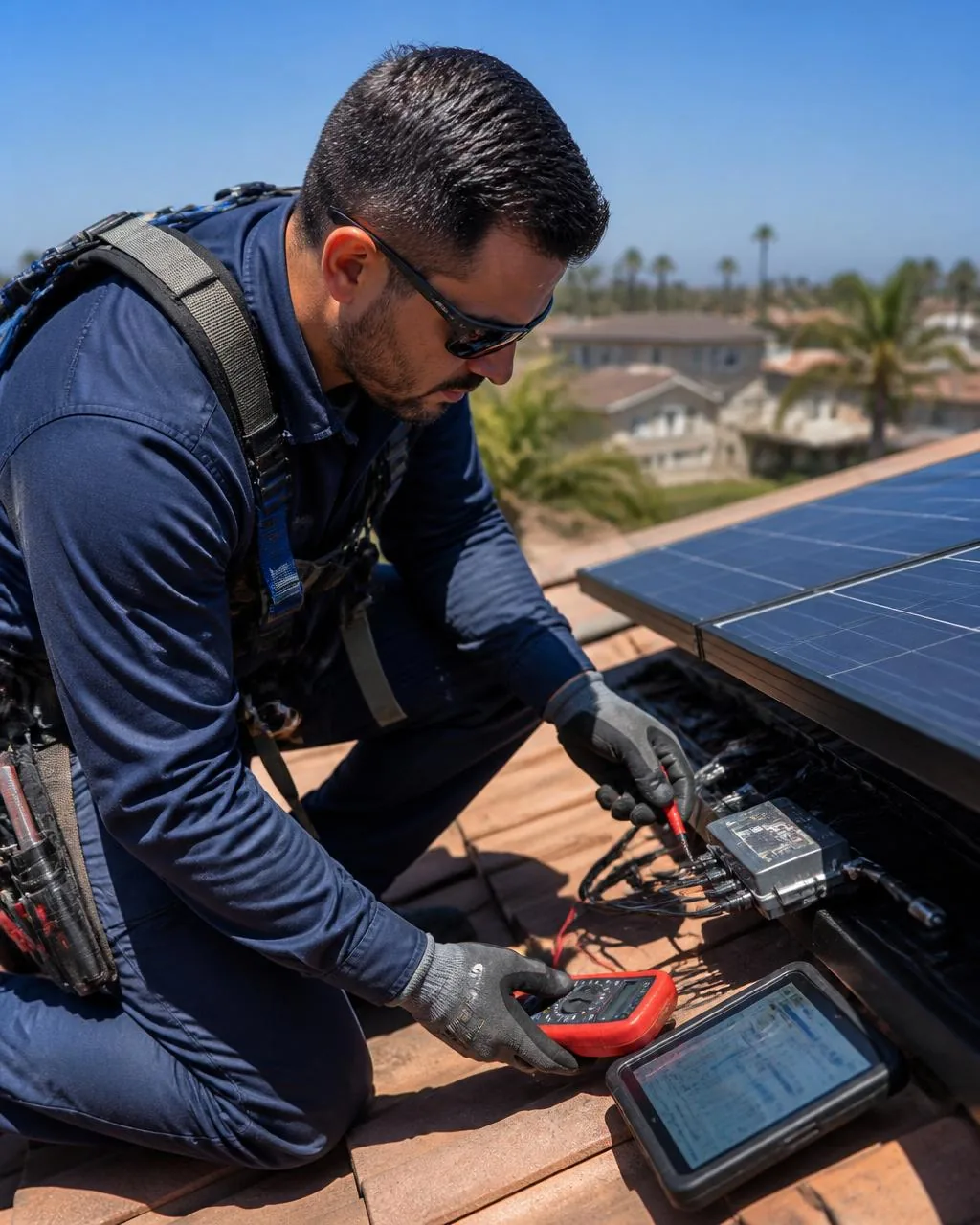
Three things fail at once, none of them are the panels.
Panels are the most durable part of a solar system. When an installer vanishes, the panels almost always keep making electricity. What breaks first is invisible: your monitoring stops reporting, so you can't tell a dead string from a healthy one.
Your workmanship warranty becomes uncollectible, a warranty is only as good as the company standing behind it. And any open interconnection paperwork or unfinished permit stalls, leaving the system technically non-compliant.
The good news: manufacturer warranties on the panels, inverters, and batteries almost always survive. They're contracts between you and Qcells, Enphase, Tesla, SolarEdge, Panasonic. You just need a licensed contractor to file them. Nuon Energy is that contractor.
Start with the diagnosis
We will pull your equipment serials, check warranty status and tell you what is still covered.
Audit. Diagnose. Repair. Warrant.
Audit
One site visit
A full system inventory, panels, inverters, batteries, wiring, permit history, and the last twelve months of production against what the design promised.
Diagnose
Written report
IV-curve testing on suspect strings, inverter fault-log pull, monitoring re-provisioning, and a plain-language report on what's working, what's failing and why.
Repair
Parts and labor
Failed microinverters swapped, string inverters replaced under warranty when possible, degraded panels flashed or replaced, monitoring back online.
Warrant
10 year coverage
Everything Nuon touches carries our 10-year workmanship warranty from the day the repair leaves site. You have one number to call from that day forward.
If you're seeing any of this, don't wait.
Orphaned systems degrade quietly. A dead microinverter shows up on the bill months before it's obvious on the roof. Catching it early is the difference between a same-week repair and replacing a whole string.
- Monitoring app hasn't updated in weeks or months.
- utility bill spiking despite panels being on the roof.
- Original installer's phone disconnected or website down.
- Visible corrosion, loose conduit or broken glass on panels.
- Inverter showing red or orange status LED, or fault codes.
- System age approaching the 10-year workmanship cliff.
Manufacturer coverage we file on your behalf.




Next step
System dark, app offline, or your installer gone? We will tell you what is actually wrong.
Four things worth knowing before you assume the worst.
When an installer folds, most homeowners are told two wrong things: that the whole warranty is void, and that the system has to be replaced. Neither is usually true. Here is what actually survives.
The manufacturer warranties are intact.
Qcells, REC, Tesla, Enphase and SolarEdge warrant their own hardware. Those terms sit with the equipment on your roof and follow the property, not the contractor. A ten-year-old array with a failed microinverter is very often a free part and a few hundred dollars of labor, provided a certified installer files the claim correctly.
The workmanship warranty is the real loss.
Flashing, mounts, conduit runs, wire management and roof penetrations were covered by the installer, and that coverage evaporated. This matters because rushed installs from companies that later failed tend to have exactly those defects. We inspect for them first, since a leaking penetration costs far more to ignore than to fix.
Monitoring can be recovered under your own account.
Defunct installers often held the monitoring account, so when the company disappeared the data feed went with it. The hardware is still fine. We re-register the gateway under your name and email so you own the login permanently and no future contractor can hold your production data hostage.
The loan and the installer are separate problems.
A finance company does not stop collecting because the installer closed. What can move the needle is documented non-performance: a written technical report showing the system is not producing what was sold. Servicers do sometimes pause or renegotiate on that basis. We write the report, you take it to them.
What orphaned system work typically costs.
Every one of these starts with a diagnostic, because quoting a repair from a phone description is how homeowners get sold parts they did not need. If the fix turns out to be a $200 reset, we will tell you that.
| Service | Typical range | What is included |
|---|---|---|
| Full system diagnostic | $350 to $650 | String testing, thermal imaging, roof penetration check, written report with photos. Credited toward repair. |
| Monitoring re-commissioning | $250 to $500 | New gateway registration under your own account, wifi or cellular, plus a walkthrough of the app. |
| String inverter replacement | $2,200 to $4,500 | Includes hardware, disconnect, commissioning and manufacturer claim filing if the unit is still in warranty. |
| Microinverter replacement | $300 to $600 each | Per unit, roof access included. Usually free hardware under the Enphase 25 year warranty, you pay labor. |
| Roof penetration repair | $400 to $1,800 | Re-flashing and sealing leaking mounts, the most common failure from rushed installs. |
| Panel removal and reset for roofing | $3,500 to $7,000 | Detach, store, and reinstall the array so the roof underneath can be replaced properly. |
Southern California pricing for 2026. Hardware still covered by an active manufacturer warranty is supplied at no cost once the claim is approved, you pay labor and roof access only.
Find out what is actually wrong before you spend anything.
Send us the make of your panels and inverter and a photo of the array. We will tell you what is likely failing and whether it is still under manufacturer warranty.
Orphaned system questions, answered plainly.
- My solar installer went out of business. Is my warranty gone?
- Part of it. A solar system carries three separate warranties and only one of them died with the installer. The panel warranty (typically 25 years) and the inverter warranty (10 to 25 years) come from the manufacturer and are attached to the equipment, not the company that screwed it down. What you lost is the workmanship warranty, which covers labor, roof penetrations and the flashing. That is the piece Nuon can pick up once we have inspected the array.
- Can Nuon service equipment we did not install?
- Yes, and a large share of our service calls are exactly that. We are certified on Tesla, Enphase, SolarEdge and Qcells hardware and we can file manufacturer claims on your behalf regardless of who did the original install. The one thing we ask is a paid diagnostic first, so nobody is guessing about what is actually wrong.
- How do I file a manufacturer warranty claim without the original installer?
- You need the serial numbers, the install date and proof of proper installation. We pull the serials during inspection, photograph the array and submit the claim directly to Enphase, Tesla, SolarEdge or the panel manufacturer as a certified installer. Homeowners can file on their own, but manufacturers usually require a licensed contractor to perform the diagnosis and the replacement anyway.
- My monitoring stopped working. Does that mean the system is down?
- Not necessarily, and this is the single most common call we get. Monitoring runs through a gateway or combiner that talks to your home wifi. A router change, an ISP swap or a defunct installer's dead monitoring account will all cut the data feed while the array keeps producing normally. We re-commission monitoring under your own account so you own the login going forward.
- What does a system inspection cost?
- A full diagnostic runs $350 to $650 depending on array size and roof access, and it includes string-level testing, IV curve tracing where applicable, thermal imaging of the modules, a roof penetration check and a written report with photos. If you proceed with the repair, we credit the diagnostic against the work.
- The company that installed my system was financed through a lender. Do I still owe?
- Almost always yes. The loan or lease is a separate contract with a finance company, and their bankruptcy is not your escape hatch, nor is the installer's. What you can often do is get the servicer to pause payments while a documented non-performance issue is being resolved. Bring us the paperwork and we will write the technical letter for you.
- Is it worth repairing an older system or should I replace it?
- If the panels are under fifteen years old and the roof underneath is sound, repair is usually the better economics: a failed inverter is a few thousand dollars against a full replacement. Where we recommend replacement is when the roof is at end of life, when the array is undersized for how the household actually uses power now, or when a NEM 3.0 battery retrofit means redesigning the system anyway.
Related work from the same crew.
Main service panel upgrades
Older arrays paired with new batteries or EV chargers often outgrow the original service. Here is how we assess it.
Read moreBattery storage retrofits
Adding storage to an existing array is the most common way to fix NEM 3.0 economics on an older system.
Read moreResidential roofing
If the roof under your array is at end of life, the panels come off and go back on as one coordinated job.
Read more