
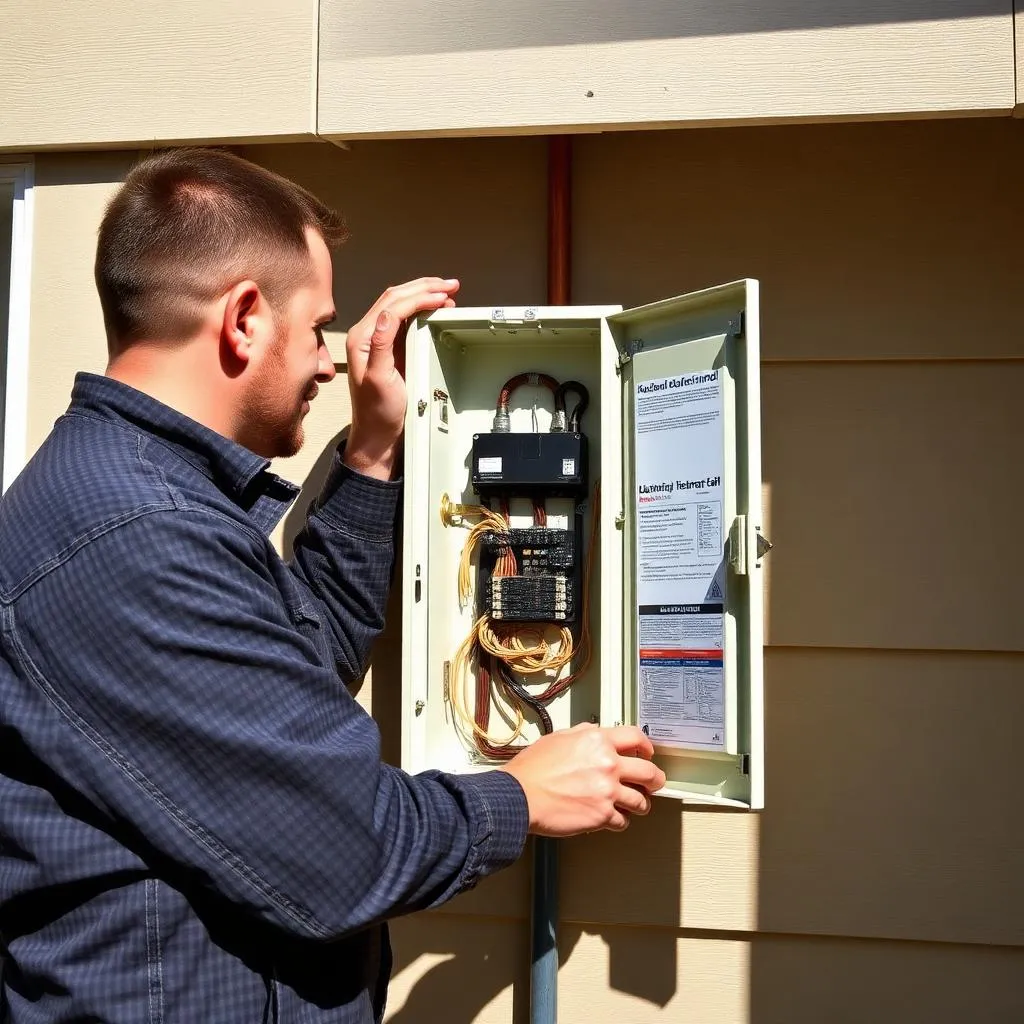
The quiet upgradethat unlockseverything else.
Homes built before 2000 usually have a 100A or 125A panel, not enough headroom to safely add solar, a battery, and a Level 2 EV charger. Nuon Energy pulls the permits, coordinates the utility, and upgrades your panel to 200A or 225A so every future addition drops in cleanly.
We review your service photos and utility requirements first, then verify details on site before install.
The NEC 120% rule, in plain English.
The National Electrical Code limits how much power can back-feed a residential busbar to 120% of its rating. A 100A panel can only accept a small solar array with no battery, and once you add storage and an EV charger to the load side, the math stops working.
Upgrading to a 200A panel (or a 225A smart panel like Span or Lumin) gives you 40 to 80A of headroom. Suddenly the solar array grows, the battery system back-feeds cleanly during an outage, and the EV charger runs at full 48A instead of throttled.
A residential MSP upgrade is a single-day job when it's planned right. We handle the permitting, the utility scheduling, the meter socket, the grounding and the inspection walk in one visit.
Find your headroom
Send a photo of your panel label and we will tell you if it can carry solar, a battery and an EV charger.
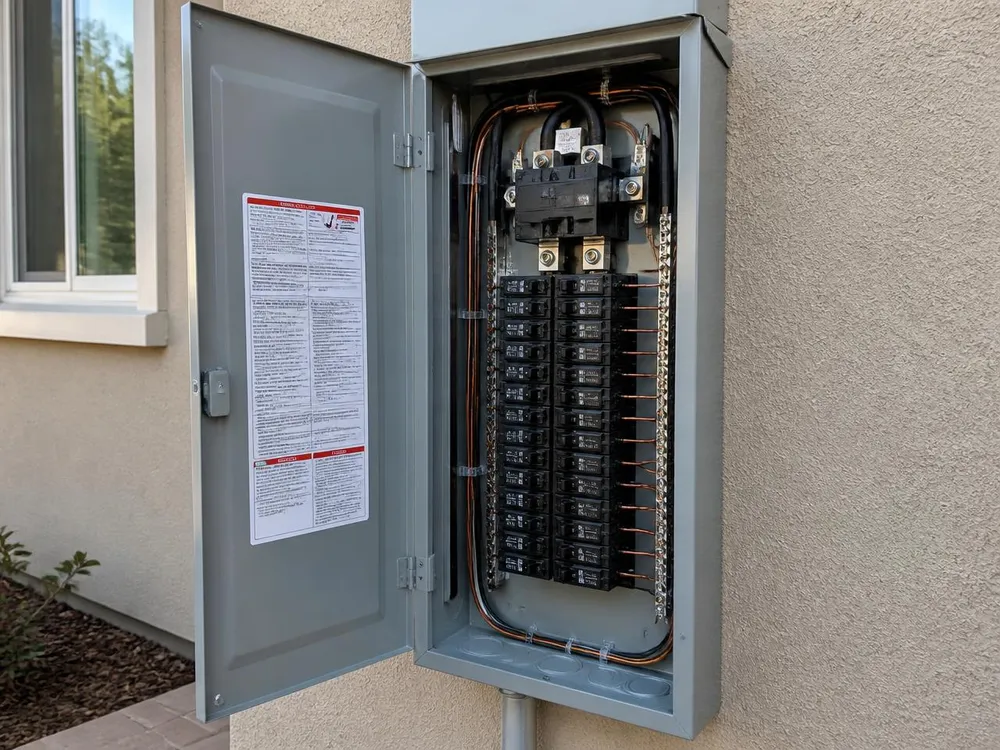
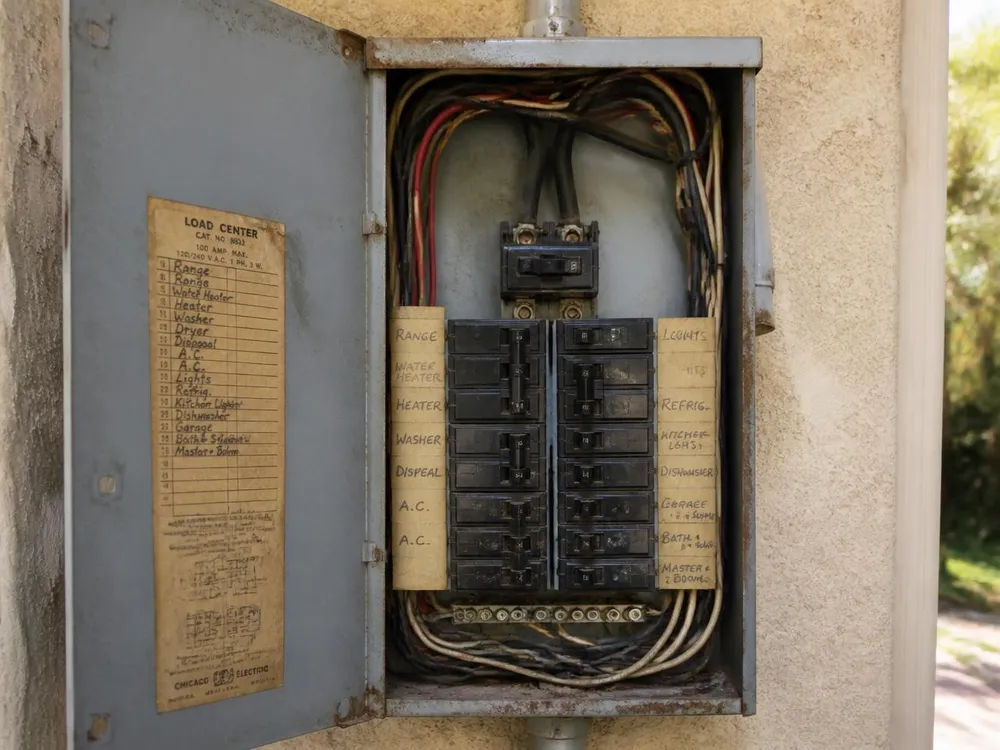 BeforeAfter
In by breakfast. Reconnected by dinner.
The utility cuts service at the meter. Our crew stages the new panel, meter socket, breakers and grounding hardware on-site.
Licensed electricians remove the old panel, mount the new 200A or 225A busbar, and re-land every branch circuit with fresh AFCI/GFCI breakers per current CEC.
AHJ inspection walks the job, the utility returns to reconnect service, monitoring comes back online, and your home is running on a panel that's ready for what's next.
Book the day
Most upgrades are one day, start to reconnect. We handle permits and the utility scheduling.
A complete, permitted panel replacement.
- New 200A or 225A main breaker panel (Square D, Eaton or Siemens).
- Meter socket replacement if required by the utility.
- Grounding electrode conductor and bonding to current code.
- AFCI and GFCI breakers per current CEC.
- Permit filing and AHJ inspection coordination.
- Utility disconnect and reconnect scheduling.
Any of these? Put an upgrade on the list.
- Panel labeled 100A or 125A.
- Federal Pacific, Zinsco or Pushmatic (safety-recall risk).
- Fuses instead of breakers.
- No room for new breakers, or double-taps present.
- Planning solar, battery, and EV charger in the next five years.
- Home built before 1990 with original electrical service.
Next step
Not sure whether your panel has headroom for solar, storage and an EV charger?
Four things decide whether your panel needs replacing.
Not every old panel is a problem, and not every new panel is safe. Before we quote anything, an electrician walks the service from the weatherhead to the last breaker and reports on these four.
Busbar rating versus planned load.
We add up what you have and what you are planning: array size, battery charge and discharge rate, EV charger amperage, heat pump, induction range, pool equipment. Then we compare that against the busbar rating and the 120 percent back-feed allowance. If the number does not clear with room to spare, the panel is the limiting factor and everything downstream gets designed around it.
Brand and vintage risk.
Federal Pacific Stab-Lok, Zinsco and Pushmatic gear has a documented history of breakers failing to trip. Insurers in California increasingly refuse coverage on homes that still have them. We photograph the label, the bus and the breaker seating, and if it is one of those brands the recommendation is replacement regardless of capacity.
Grounding, bonding and the service entrance.
A panel is only as safe as the ground it sits on. We check the grounding electrode conductor, the water bond, the mast or lateral condition and the meter socket. Homes from the 1960s often have a single driven rod and no supplemental electrode, which does not meet current code and has to be corrected as part of the upgrade.
Whether a smart panel earns its cost.
Span and Lumin panels manage load dynamically, which can let a home add an EV charger without a service increase and gives you circuit-level control of what stays alive during an outage. They cost roughly double. We recommend one when backup priority genuinely matters and skip it when a conventional 200A panel does the same job for less.
What the line items look like on a real quote.
Panel upgrades get quoted as one number, which makes them hard to compare between contractors. Here is how ours breaks apart so you can hold any other bid against it.
| Line item | Typical range | When it applies |
|---|---|---|
| 200A panel replacement | $3,500 to $5,500 | Like-for-like location, overhead service, standard Square D or Eaton gear, permit and inspection included. |
| 225A or smart panel | $6,000 to $11,000 | Span or Lumin hardware, app-controlled circuit backup, worthwhile when a battery is in scope. |
| Meter socket replacement | $600 to $1,400 | Required by the utility when the existing socket is damaged, undersized or a discontinued type. |
| Service mast or riser | $900 to $2,200 | Overhead services with a corroded or short mast need it rebuilt to current clearance rules. |
| Underground service lateral | $3,000 to $9,000 | Trenching, conduit and conductor from the transformer or pedestal, priced by distance and surface restoration. |
| Subpanel for garage or ADU | $1,200 to $2,600 | Common add-on when the EV charger, heat pump or accessory unit sits far from the main. |
Southern California pricing for 2026 including permit fees and inspection coordination. Final pricing follows an on-site assessment. Panel upgrades performed alongside a solar or battery install are usually cheaper than standalone work because mobilization and permitting are shared.
Find out whether you actually need one.
Send a photo of your panel label and we will tell you, honestly, whether an upgrade is required for what you are planning. Plenty of homes do not need one.
Panel upgrade questions, answered plainly.
- How much does a main service panel upgrade cost in Southern California?
- Most residential 200A upgrades land between $3,500 and $6,500 installed and permitted. The spread comes from meter socket replacement, whether the service is overhead or underground, how far the panel sits from the meter, and how much of the existing branch wiring is still serviceable. Homes that need a new mast, a trenched service lateral or asbestos-era wiring remediation run higher, and we tell you that before we start, not after.
- How long does the work take?
- The physical swap is a single day for most homes. Power goes out in the morning when the utility pulls the meter and comes back the same afternoon after the inspector signs off. The longer part is scheduling: permit issuance runs one to three weeks depending on the jurisdiction, and the utility disconnect appointment has to line up with the inspection window.
- Do I need a permit for a panel upgrade?
- Yes, always. A main service panel replacement is a permitted, inspected job in every Southern California jurisdiction. Anyone offering to swap your panel without pulling one is putting your homeowner's insurance and your future home sale at risk. We file the permit, meet the inspector and hand you the signed card.
- Do I need 200A for solar, or is 100A enough?
- It depends on the array size and what else is on the load side. The NEC 120 percent rule caps how much a solar breaker can back-feed the busbar. A modest array with no battery can sometimes fit on 100A service using a line-side tap. Add a Powerwall and a 48A EV charger and the math almost always fails. If you plan to do all three within five years, upgrading once is cheaper than paying mobilization twice.
- Will I lose power during the upgrade?
- Yes, for most of the working day. We stage the new panel and hardware before the utility disconnects, so the outage window is typically six to eight hours. Plan for the refrigerator, medical equipment and anyone working from home. On request we can bring a generator for critical loads.
- What is a Federal Pacific or Zinsco panel, and why does it matter?
- Both were widely installed from the 1950s through the early 1980s and both have documented failures where the breaker does not trip under fault conditions. Many insurers now refuse to write or renew a policy on a home with one. If your panel has either label, replacement is not a maintenance upgrade, it is a safety correction.
- Should I install a smart panel instead?
- A smart panel like Span or Lumin lets you control circuit-by-circuit backup priority from an app and can sometimes avoid a service size increase through load management. It costs roughly twice a conventional 200A panel. It makes the most sense on homes with battery backup where deciding what stays on during an outage really matters.
Related work from the same crew.
Tesla Powerwall installation
Backup sizing, gateway placement and what a Powerwall needs from your service panel.
Read moreSolar PPA and financing
Cash, $0-down loan or PPA. A panel upgrade can usually be financed into the same package.
Read moreResidential solar panels
Design, permitting and utility interconnection from the crew that pulled the panel permit.
Read more