

$0 down, or own it outright.We'll show youboth.
A Power Purchase Agreement means solar with no upfront cost, you just buy the electricity your roof produces at a locked rate. Nuon Energy underwrites PPAs, $0-down loans and cash purchases through vetted lenders, then hands you the side-by-side math so you can pick what actually pencils.
Cash, loan and PPA modeled on your real utility bill. Free, no obligation.
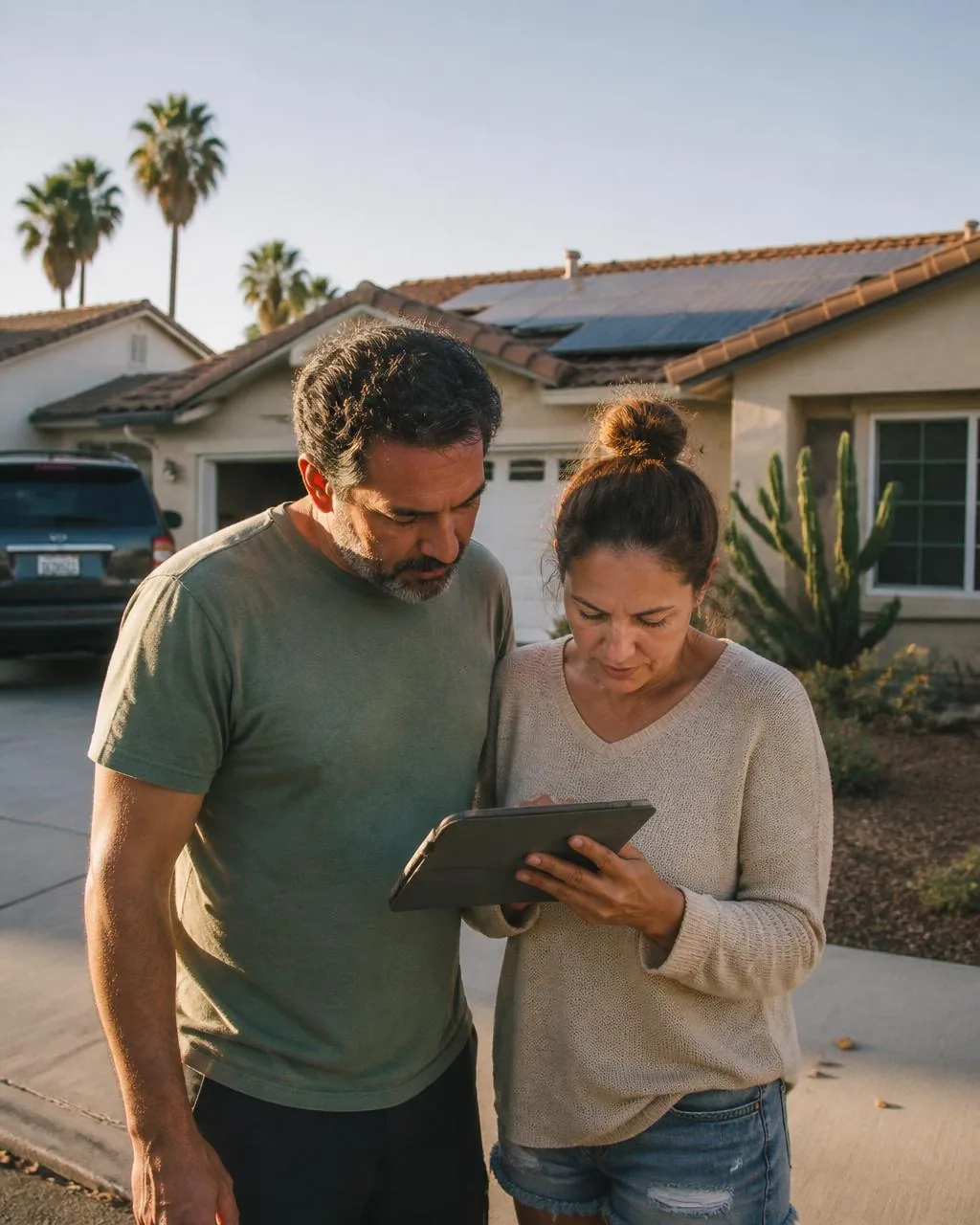
A long-term electricity contract, not a solar loan.
A Power Purchase Agreement is a 20 to 25 year contract where a third-party solar owner installs and maintains a system on your roof at no cost to you. In return, you buy the electricity it generates at a fixed per-kWh rate, typically 20 to 30% below what your utility currently charges.
You don't own the equipment, which means you don't claim the federal clean energy tax tax credit, the PPA provider does. But you also don't carry the maintenance, monitoring, or warranty risk. It's the closest thing solar has to a utility bill you can actually afford.
For businesses, PPAs are often the fastest way to deploy solar without hitting the capital budget. For homeowners under NEM 3.0, PPAs are back in the conversation because they skip the payback math entirely, you're just swapping a higher utility bill for a lower solar bill on day one.
See your own numbers
We will read your last utility bill and show what a PPA costs you per kWh versus owning.
Three ways to go solar. One of them is right for you.
- You own the system from day one.
- Full federal clean energy tax credit lands on your return.
- Typical payback in 6 to 8 years, then free electricity.
- You own the system and keep the federal clean energy tax credit.
- Monthly payment is usually below your current utility bill.
- Refi-friendly, pays off with the tax-credit lump sum.
- One upfront payment covers the full 20 or 25 year term.
- Can land roughly 20% below a standard PPA over the term, case by case.
- No monthly bill, no escalator, maintenance still sits with the owner.
- A third-party owner installs the system on your roof.
- You buy the electricity it produces at a locked kWh rate.
- Monitoring, warranty and repair sit with the PPA provider.
Still deciding
Cash, loan or PPA? Give us 15 minutes and we will model all three on your real usage.
Why the financing math changed in 2023.
NEM 3.0 cut export credits by roughly 75%, which means panels alone no longer pencil the way they did five years ago. Adding a battery flips the math, you store the daylight surplus and use it in the expensive evening window instead of selling it back to the grid for pennies. Every quote we hand you assumes storage, because in Southern California, in 2026, that's the only assumption that holds.
When a PPA is not the right answer.
- You have the cash on hand: a cash purchase almost always wins on lifetime math.
- You have tax appetite to absorb the full federal clean energy tax credit: a loan lets you keep it.
- You plan to sell the home in 3 to 5 years: PPA transfer paperwork can slow closing.
- You want maximum long-term savings: on a PPA you own the electricity, not the panels.
Next step
Want the cash, loan and PPA numbers side by side for your own roof?
What actually drives the number on your financing quote.
Two houses on the same street can get quotes $9,000 apart and both be fair. Here is what moves the figure, so you can read any proposal, ours included, without taking anyone's word for it.
Your real consumption, not a national average.
We pull twelve months of utility usage in fifteen-minute intervals through your Green Button data. A household that runs the air conditioning at 5pm needs a different system than one that leaves for work at 7am, even at identical annual kWh. Sizing off an annual total is how people end up with an array that covers the bill on paper and misses it in August.
The escalator, and whether there is one.
PPA rates either stay flat for the term or climb by a fixed percentage each year, usually between 1.9 and 2.9 percent. A 2.9 percent escalator on a 25 year contract nearly doubles your rate by the final year. Flat-rate PPAs start higher and finish far lower. Ask for both versions and compare year fifteen, not year one.
Tax appetite and who can use the credit.
Federal clean energy incentives are only worth something to a taxpayer with liability to offset. Retirees on fixed income, nonprofits and some small businesses cannot use them fully. That single fact is what pushes a lot of otherwise loan-friendly clients toward a PPA, where the owner monetizes the credit and prices it back into the rate. Confirm tax treatment with your advisor before choosing a financing path.
Storage, and how much of the evening you want covered.
One battery covers the essentials through a normal utility peak window. Two covers a whole house through most outages. Under NEM 3.0 the battery is doing the financial work, shifting daylight production into the 4pm to 9pm block instead of exporting it for a few cents. Storage capacity is usually the biggest single line item after the array itself.
What Southern California homeowners and businesses actually pay.
These are the ranges we quote most often in 2026. Your real number depends on roof complexity, panel headroom, shading and whether storage is in scope. We start with satellite and aerial imagery, utility usage, and photos, then verify the design with a timely site survey before install.
| Path | Typical range | What to know |
|---|---|---|
| Cash purchase | $18k to $34k typical | 6 to 8 year payback on a 6 to 9 kW residential array, then the electricity is free for the remaining warranty life. |
| $0-down loan | $110 to $260 per month | 25 year terms are common. The tax-credit lump sum in year one re-amortizes the loan if you apply it. |
| Residential PPA | $0 upfront, 14 to 22 cents per kWh | Rate is locked with an escalator of zero to 2.9%. Compare it against your current utility blended rate, not the peak rate. |
| Prepaid PPA | One upfront payment | Buys the whole term at once and can come in around 20% under a standard PPA over the same years. Worth modeling if you have the capital but not the tax appetite. |
| Commercial PPA | $0 upfront, negotiated per kWh | Off balance sheet for many organizations. Terms of 20 to 25 years with buyout windows written in. |
| Battery add-on | $9k to $18k installed | Required for NEM 3.0 math to work. Storage is what converts a low export credit into avoided evening consumption. |
| MSP upgrade | $3.5k to $6.5k | Needed when the existing panel is 100A or 125A. Financed alongside the array in most loan products. |
Ranges reflect recent Southern California residential and light commercial work and exclude utility fees and any structural repair found during inspection. Federal tax credit eligibility depends on your individual tax situation, please confirm with your CPA.
See all three numbers on one page.
Send us a recent utility bill and we will model cash, loan and PPA against your actual usage. No obligation, no sales visit required.
Solar financing questions, answered plainly.
- Is a solar PPA still worth it in Southern California under NEM 3.0?
- It can be, but the shape of the deal matters more than it used to. Under NEM 3.0 the export credit is worth roughly a quarter of what it was, so a PPA priced only on production can underperform. The versions that still work pair the array with storage and price the kWh so that your blended cost lands below what your utility charges in the 4pm to 9pm window. We run that comparison against your last twelve bills before we put a number in front of you.
- What is a prepaid PPA, and is it cheaper?
- A prepaid PPA settles the whole 20 or 25 year term in one upfront payment instead of a monthly per-kWh bill. Because the provider is not carrying you for two decades, the effective rate drops, and in the deals we have modeled it can come in around 20% below a standard PPA over the same term. Whether it beats a loan depends on your tax situation, so we put prepaid, standard PPA and ownership side by side on the same page rather than picking for you.
- Prepaid PPA or buying the system outright?
- Ownership wins on lifetime math when you can use the federal clean energy tax credit, because that value goes to whoever owns the equipment. A prepaid PPA makes more sense when you have cash but little tax appetite, or when you would rather someone else carry the maintenance and warranty work for the full term. We confirm tax treatment with your advisor before either number goes on a proposal.
- What is the difference between a solar PPA and a solar lease?
- A lease charges you a flat monthly rent for the equipment regardless of what it produces. A PPA charges you per kilowatt-hour, so a cloudy month costs less and a strong month costs more. Most homeowners prefer the PPA structure because you only pay for power you actually receive.
- Who repairs the system on a PPA?
- The third-party owner does, and that obligation is written into the agreement for the full 20 or 25 year term. Monitoring, inverter replacement, panel warranty claims and roof penetration leaks tied to the array all sit with them. Nuon still installs the system, so in practice our crew is usually the one on the ladder.
- Can I buy the system out later?
- Most PPA contracts include buyout windows, commonly at year six, ten and fifteen, priced at fair market value or a schedule written into the agreement. If ownership is your goal, though, a $0-down loan usually gets you there cheaper than a PPA plus a buyout.
- What happens to a PPA when I sell my house?
- The agreement transfers to the buyer, who has to qualify with the PPA provider. Plan for two to four extra weeks in escrow and give your agent the contract early. If you expect to sell within three to five years, we will usually steer you toward a loan or cash instead.
- Does a PPA affect my credit or my mortgage?
- A PPA is a service agreement, not a loan, so it does not appear as installment debt the way a solar loan does. Lenders still ask about it during refinancing because the payment is a recurring obligation attached to the property. A loan is reported as debt but builds equity in an asset you own.
- Do I still get the federal clean energy tax credit?
- Not on a PPA. The third-party owner claims it and, in a fairly priced deal, passes the value back to you through the kWh rate. If you have the tax appetite to use the credit yourself, a loan or cash purchase keeps that money in your household.
Related work from the same crew.
Main service panel upgrades
Most pre-2000 Southern California homes need 200A service before an array, a battery and an EV charger can coexist. Here is how that day goes.
Read moreHome battery storage
Under NEM 3.0 the battery is what makes the financing work. Sizing, brands and what a real outage looks like.
Read moreResidential solar installation
Design, permitting, install and utility interconnection handled by one crew under one warranty.
Read more